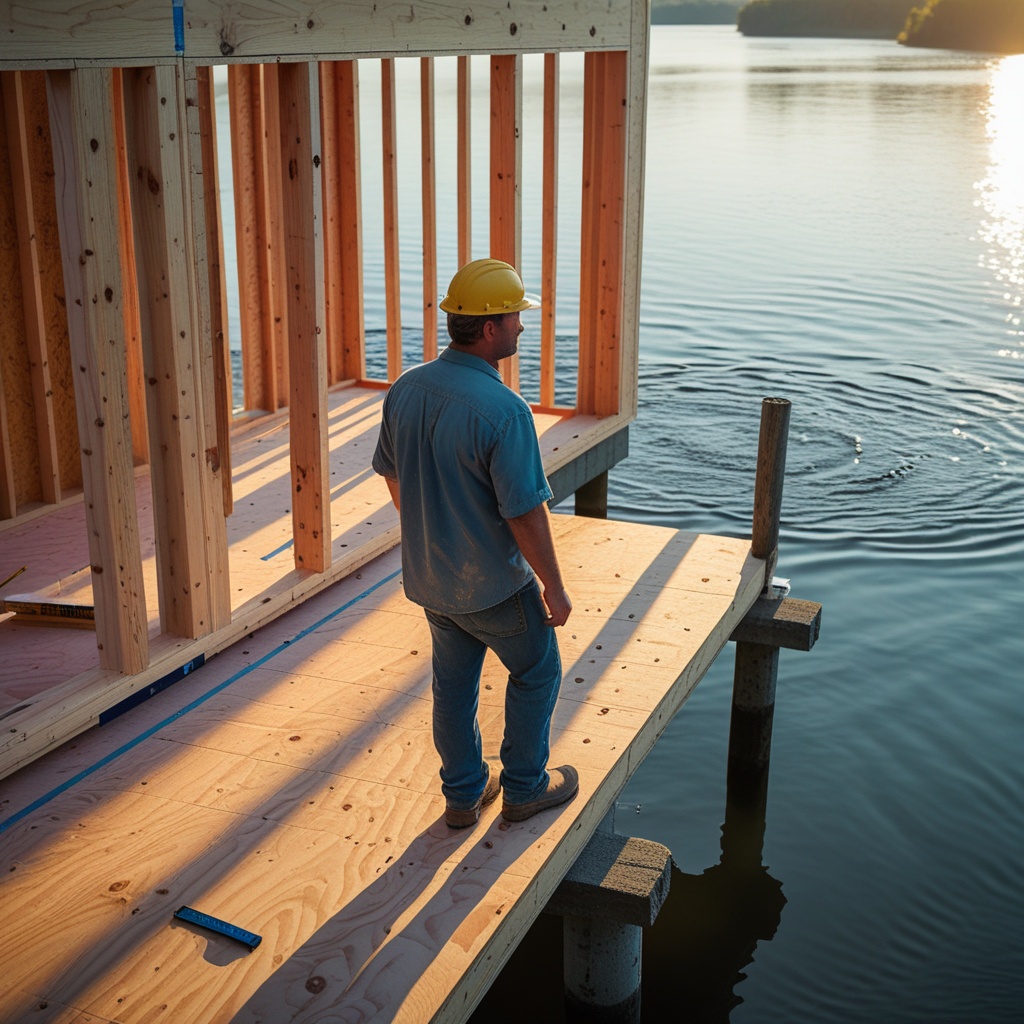
Building a private dock on riverfront land in Florida requires an Environmental Resource Permit (ERP) or a state exemption, local municipal approval, and often a federal permit from the U.S. Army Corps of Engineers, with total project costs typically running between $8,000 and $60,000 depending on size and materials. The process can take anywhere from six weeks for a small exempt dock to six months or longer for a project that triggers full state and federal review. Property owners along Florida rivers hold riparian rights under state law, but those rights do not override environmental regulations tied to submerged land, water depth, and protected species habitat. Understanding the permitting layers before you sign a contract with a builder saves both time and money.
Florida’s rivers, from the St. Johns to the Indian River Lagoon system near Titusville, sit under a patchwork of jurisdiction. The Florida Department of Environmental Protection (FDEP) or your regional water management district handles state review, your county or city handles zoning and setbacks, and the Army Corps of Engineers steps in when navigable waters or federal wetlands are involved. Skipping any one of these agencies can result in a stop-work order or a forced removal of an already-built structure.
Key Takeaways
- Most private, single-family docks under 500 square feet of over-water structure qualify for a state exemption rather than a full ERP, cutting review time significantly.
- Dock construction in Florida generally costs $150 to $400 per linear foot, with total project costs commonly landing between $8,000 and $60,000.
- Riparian rights let waterfront owners build a dock, but the dock must extend no more than 25% of the waterway’s width and cannot block navigation.
- Permitting can involve up to three separate agencies: FDEP or the local water management district, the county or city, and the U.S. Army Corps of Engineers.
- Seawalls, boat lifts, and any dredging attached to a dock project typically require additional permits beyond the dock itself.
What Permits Do You Need to Build a Dock in Florida?
Building a private dock in Florida generally requires review under Chapter 62-330 of the Florida Administrative Code, which governs the state’s Environmental Resource Permit program. Many single-family docks qualify for what the state calls a “noticed general permit” or an outright exemption, which is a simplified pathway rather than a full ERP application. Whether your project qualifies depends on the dock’s size, the water body’s classification, and whether protected habitat like seagrass or mangroves sits nearby.
A dock typically avoids full ERP review if it meets all of the following conditions under Florida Statute 403.813(1)(b):
- The dock serves a single-family residence and covers 500 square feet or less of surface area over the water (or up to 1,000 square feet in some manatee protection zones with additional conditions).
- The structure does not extend more than 25% of the width of the waterway.
- No dredging or filling of submerged land is required to install pilings.
- The dock does not impede navigation or access to adjacent riparian owners.
If your proposed dock exceeds these thresholds, or if the river segment is designated as an Outstanding Florida Water, you will need a standard ERP, which involves a more detailed application, public notice period, and review timeline that can stretch past 90 days. Rivers with documented manatee activity, such as portions of the St. Johns and Indian River systems, often require a Manatee Protection Plan consultation before FDEP issues any authorization.
When Does the Army Corps of Engineers Get Involved?
The Army Corps of Engineers reviews dock projects that affect navigable waters under Section 10 of the Rivers and Harbors Act of 1899, and projects affecting wetlands under Section 404 of the Clean Water Act. Many small residential docks qualify for a Nationwide Permit, most commonly Nationwide Permit 3 for maintenance or Nationwide Permit 18 for minor discharges, which streamlines review to roughly 45 to 60 days. Florida’s state programmatic general permit arrangement with the Corps means that, for many routine dock applications, the state ERP process satisfies both state and federal requirements simultaneously, so you are not filing two entirely separate applications from scratch.
How Much Does It Cost to Build a Dock in Florida?
Dock construction costs in Florida generally fall between $150 and $400 per linear foot, with a typical 4-foot by 40-foot residential dock landing somewhere in the $12,000 to $30,000 range before permitting fees. Material choice, water depth, and the distance the dock must travel to reach navigable depth all push the price up or down significantly.
- Pressure-treated wood dock: $20 to $45 per square foot, with a standard 320-square-foot dock costing roughly $8,000 to $14,000.
- Composite decking dock: $35 to $65 per square foot, pushing the same 320-square-foot structure to $11,000 to $21,000, but with a 25-to-30-year lifespan versus 10 to 15 years for treated wood.
- Aluminum floating dock: $45 to $85 per square foot, often chosen for rivers with fluctuating water levels, bringing total cost to $14,000 to $27,000.
- Permitting and engineering fees: $1,500 to $6,000 for exempt or noticed general permit projects; $6,000 to $15,000 or more when a full ERP, survey, and biological assessment are required.
- Boat lift addition: $4,000 to $12,000 depending on capacity, with 10,000-pound lifts common for center console boats in the 24-to-28-foot range.
Pilings driven into riverbed substrate add another variable. Sites with soft mud or sand may need pilings driven 15 to 20 feet deep, while rocky or hard-packed river bottoms in North Florida can reduce piling depth and labor time. A licensed marine contractor will typically include a soil assessment or rely on nearby permit records to estimate this before quoting a fixed price.
What Are Riparian Rights for Florida Waterfront Property?
Riparian rights in Florida give waterfront property owners the legal ability to access the water, build a dock, and use the water for reasonable purposes, but these rights come from common law and Florida Statute 253.141 rather than outright ownership of the submerged land. The state, not the property owner, typically holds title to sovereign submerged lands below the mean high-water line, which is exactly why a state permit is required even on your own waterfront lot.
Core riparian rights recognized under Florida law include the right to:
- Access the water directly from your property line.
- Build a dock or pier extending into the water, subject to permitting.
- Use the water for recreation, fishing, and reasonable navigation.
- Receive accretions or relictions (gradual land buildup from natural water movement).
- Protect against unreasonable interference from a neighbor’s construction that blocks your own water access.
Disputes commonly arise when two adjacent riparian owners disagree over where the dividing line between their water frontage falls, especially on curved riverbanks where straight lot lines do not translate cleanly to the water. Florida courts generally apply a method that divides the frontage proportionally rather than by simple lot-line extension, which is why a licensed surveyor’s riparian line determination is often requested during the permitting process on irregular shorelines.
Owning riverfront land in Florida grants the right to seek a dock permit; it does not grant an automatic right to build without state and local review, since the submerged land itself remains public.
What Are the Steps to Building a Dock on Riverfront Property?
Each step has its own timeline and cost. Skipping ahead, like hiring a contractor before confirming your riparian line, is a common cause of permitting delays.
- Confirm riparian rights and boundary lines (1 to 3 weeks, $500 to $1,500). A licensed surveyor marks your riparian line and mean high-water boundary before design work starts.
- Check exemption eligibility versus full ERP need (1 to 2 weeks, often free). A pre-application meeting with FDEP or your water management district decides whether you face a 30-to-60-day timeline or a 90-plus-day one.
- Hire a marine contractor or engineer for design (2 to 4 weeks, $1,000 to $3,500). Designs must specify dock footprint, piling placement, and materials to match the permit application.
- Submit state and federal applications (30 to 90 days, $1,500 to $15,000 in fees). Filing through FDEP’s ePermitting portal or your water management district triggers state and, where applicable, joint federal review.
- Get a local building permit and clear zoning setbacks (2 to 6 weeks, $150 to $600). Counties like Brevard often require dock setbacks from side property lines, commonly 25 feet.
- Construction (2 to 6 weeks, $8,000 to $30,000). Weather and river water levels can stretch this window during Florida’s rainy season from June through September.
- Final inspection and certificate of completion (1 to 2 weeks, usually included in permitting fees). This confirms the finished structure matches approved drawings before you can legally use the dock.
How Long Does the Entire Process Usually Take?
A dock that qualifies for a state exemption and skips federal review can go from survey to finished construction in about 8 to 14 weeks. One that needs a full ERP, a federal individual permit, or a Manatee Protection Plan review can take 6 to 12 months. Rivers with seagrass beds or Outstanding Florida Water status, common near the Indian River Lagoon watershed by Titusville, usually land in that longer timeline due to extra biological review.
Do You Need a Seawall Permit Too?
A seawall requires its own separate permit from FDEP or the water management district, distinct from the dock permit, because it involves shoreline stabilization and often some fill placement. Seawall construction in Florida generally costs $400 to $900 per linear foot for concrete or vinyl systems, meaning a 100-foot seawall runs $40,000 to $90,000 before dock costs are added. If your property already has an aging or failing seawall, addressing that structure first is generally more cost-effective, since dock pilings installed before a seawall repair sometimes need to be reworked once shoreline stabilization work begins.
Riprap (loose stone) shoreline protection offers a lower-cost alternative at roughly $75 to $150 per linear foot, though it is not suitable for every riverbank depending on erosion severity and current speed. A geotechnical assessment, often costing $800 to $2,500, will identify whether your particular stretch of riverbank needs a full seawall or can rely on riprap or living shoreline plantings instead.
What Should You Look for Before Buying Riverfront Land for a Dock?
Water depth at the shoreline matters more than most buyers realize, since a river segment with less than two feet of depth at mean low water may require extensive dredging permits before any dock becomes functional for boat access. Checking existing permit records for neighboring properties through your county’s environmental permitting portal gives a realistic sense of what has been approved nearby and how long those approvals took.
Buyers should also confirm whether the parcel falls within a designated Outstanding Florida Water, an Aquatic Preserve, or a mapped manatee protection zone, since each designation adds review layers and sometimes seasonal construction restrictions (commonly November through March in manatee zones). For anyone shopping specifically with dock access in mind, it is worth reviewing riverfront parcels where dock permitting is already feasible, since prior owner permit history or established riparian lines can shave months off your own application timeline.
What Documents Should You Request From a Seller?
- Any prior dock, seawall, or boat lift permits filed with the county or FDEP.
- A current survey showing the mean high-water line and riparian boundary.
- Flood zone designation (many riverfront parcels fall in FEMA Zone AE, affecting insurance and construction requirements).
- Any recorded easements affecting water access or adjacent riparian lines.
Call to Action
Dock feasibility and riparian boundaries are specific to each individual parcel, not a general rule that applies across an entire river frontage. Before making an offer on riverfront land or finalizing your dock design, ask our team about riparian rights before you build so you understand exactly what permitting path applies to the property you are considering.
Conclusion
Building a private dock on Florida riverfront land is entirely achievable for most property owners, but it is a multi-agency process rather than a single application. Confirming your riparian rights, checking exemption eligibility, and budgeting realistically (generally $8,000 to $60,000 depending on size, material, and whether a seawall is also needed) sets a project up for a smoother approval. The owners who move fastest through permitting are almost always the ones who checked their water depth and riparian line before falling in love with a specific property. Working with a licensed marine contractor familiar with your specific river segment, whether that is the St. Johns, the Indian River, or a smaller tributary, remains the most reliable way to avoid costly redesigns mid-project.
Frequently Asked Questions
Can you build a dock without a permit in Florida?
No, virtually every private dock in Florida requires either a state exemption confirmation or a formal permit. Even docks small enough to qualify for an exemption under Florida Statute 403.813 still need to be registered or confirmed with FDEP or the local water management district before construction begins.
How wide can a private dock be on a Florida river?
A private dock generally cannot extend more than 25% of the width of the waterway it sits on. This rule protects navigation for other boaters and adjacent riparian owners, and narrower rivers often face tighter practical limits than this percentage suggests.
Do you need a permit for a boat lift in addition to a dock permit?
Yes, a boat lift typically requires its own authorization even when attached to an already-permitted dock. Most residential boat lifts fall under the same exemption or noticed general permit category as the dock itself, but the lift specifications must be included in the application.
How close to a property line can you build a dock in Florida?
Most Florida counties require a setback of at least 25 feet from side riparian lines, though this figure varies by local ordinance. Brevard County and several other coastal counties apply this standard to prevent docks from crowding a neighbor’s water access.
Is a seawall required before building a dock on riverfront property?
No, a seawall is not required to build a dock, and many riverfront properties use natural shoreline or riprap instead. A seawall becomes necessary only if erosion, current strength, or wake action threatens the stability of the bank near the proposed dock structure.